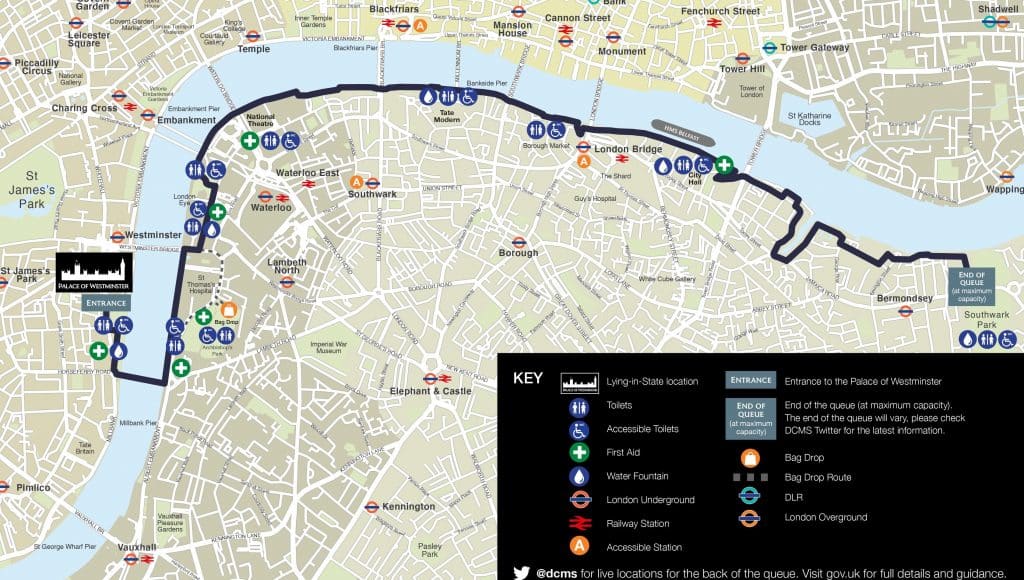
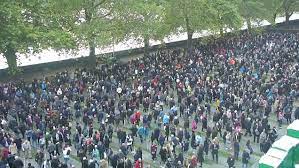
Among the noteworthy incidents taken place in the United Kingdom with the passing away of Queen Elizabeth II on 8th of September 2022, is the enormously long queue of mourners lined to pay their last respect to the late Queen at the Palace of Westminister in London. The queue was miles long and people wait for more than 14 hours to reach the final destination; Westminister Hall which sits within the Palace of Westminister. They wanted to celebrate the life of their queen, pay respect or simply to witness an iconic event. A digital app shows the path of the queue, notify the start of the queue, gives updates of nearest facilities and tea/coffee making spots. This drawn-out queue is monitored using CCTV cameras, monitored by the Police. In fact, it is the most watched, googled queue in the UK and in the world currently. It is the queue of the queue, ‘The Queue’.
Digital app of the Queue
An Englishman, even is he’s alone, will form an orderly queue of one.
George Mikes
Not only English, queuing is what most Britons are renowned for doing -better than most of the other nations. As an expatriate living in the United Kingdom, I can vouch that British queueing manners are far better when standing in a line, waiting for the turn and respecting the personal space of the person ahead of you.
Further, we are familiar with ‘social distancing’ queues two years ago due to Covid-19 pandemic. People queued to shop for essential purchasing needs of their lives – at grocery stores, super markets, butchers, restaurants, and clothe shopping, etc. This is common for nationals of most of the other countries who were heavily affected by the Covid-19 pandemic, including Sri Lanka, my home country.
According to my personal experience, manners of Sri Lankans behaviour in queuing is far inferior compared to the British. A vast majority of Sri Lankan hardly respect the order of a queue and would not hesitate to jump ahead of a queue covertly or even by force. They hardly respect the personal space of the person ahead. I often had argued while living in Sri Lanka for disrespecting the order of a queue or invading my personal space.
There were ‘socially distanced’ queues for grocery stores, transport, medical facilities in Sri Lanka during the Covid-19 pandemic similar to other countries. While others ditch the queues during post-Covid period, Sri Lankans had to tolerate queues- to buy essential groceries, fuel, cooking gas, and fertiliser for farming. These queues are long, just like ‘The Queue’, however, the atmosphere is rather different. Sri Lankans was crushed from the economic hardships and arbitrary management of the country. These essentials were scarce, hence the public had to stand in a queue to buy them. The Sri Lankan public was angry and desperate to buy the limited commodities. Some people died while standing in the queue, some were murdered, and robbed. Military persons had to be deployed in order to maintain order of the queue. Most recently, when Brits queue in London, Sri Lankans queue in Colombo for a ‘walk-in’ interview conducted by the Qatar Airways. The queue was several miles long.
Sri Lankans queuing for Qatar Airways ‘walk-in’ job interviews in Colombo
Recently nationals of both countries stayed on queues, British wanted to celebrate the life of their late queen, Sri Lankans wanted survive their lives. Thereupon, a queue here and a queue there – different purpose and a different experience.
This is a piece of writing I did for the summer newsletter of ‘Women’s Empowerment Sri Lanka (WE-Sri Lanka)’ a UK based group of women from diverse backgrounds working together to encourage, enable and empower Sri Lankan women’s lives.
The ongoing economic crisis in Sri Lanka due to long-term and short-term mismanagement by the administration has caused a dilemma in the society which erupted a couple of months ago with the populace heralded anti-government demonstrations; the ‘Aragalaya – The people’s movement’. People of all walks of life rose to defend and support the protestors and retaliate against the bullying tactics carried out by the Sri Lankan administration and law and order upholders. Women representation was conspicuous in this historic movement. They experience dire consequences due to the ongoing economic chaos, unable to manage household activities and earnings. An image of a mother raising one hand in protest while carrying her young child has become an iconic symbol of the uprising. Not only her, women of all ages, all races and classes added a different dimension to the people’s movement.
Women in Sri Lanka are often trained to keep their head down and maintain ignorance to the socio-political changes in the society even though it has a direct impact on them. However, the ‘Aragalaya’ changed the mindset of Sri Lankan women and gave courage to express their socio-political views. We saw women’s expression of protest through art, voice, action, and words. We saw pregnant women walking alongside the rallies, mothers accompanying their children, veteran artists supporting the younger generation, young female university students braving the tear gas and water cannons, We saw lawyers acting against unlawful arrests of protestors, healthcare workers volunteering at protests grounds, women cooking meals for protestors. We saw young children with a Sri Lankan heritage at the forefront of the protest in the United Kingdom, Australia, and the USA.
We saw sisterhood, motherhood and the uncanny bravery of Sri Lankan women loud and clear through the people’s movement for a better Sri Lanka.
Today, the 11th of April, 2022 this hashtag, #GoHomeGota is trending worldwide and gaining the attention of the rest of the world in many social media platforms, which is the aim of a majority of the Sri Lankans. To my fellow non-Sri Lankans who read this article, this is a tag line created in order to remonstrate against the current ruling party members and the president of Sri Lanka, Gotabhaya Rajapaksha, who is also famously addressed as ‘Gota’. The hash tag asks him to renounce his presidency and leave the country (He is actually a US citizen, who has managed to become the president of the Sri Lanka through a chain of misconducts).
As we speak, Sri Lankans as a society facing tremendous hardships due to the extreme high prices of essential and basic groceries and food and lack of gas, petrol and lengthy electricity cuts. People have been living with these hardships over the last couple of months. The latest addition to the crisis is the lack of essential and life saving medicine in hospitals. However, the Sri Lankan administration, the ministers and their supporters have been avoiding the issue, while trying to pass the blame to the previous governing parties, the ongoing Ukrain – Raussia war and Covid-19 pandemic. While these are some of the reasons for the ongoing issue, they definitely are not the main reasons, but; economic mismanagement, soaring external debts, depleting foreign exchange reserves and also weekend currency.
Cost of basic necessitiesExchange rate
FINALLY, PEOPLE OF SRI LANKA HAD ENOUGH OF THIS DRAMA. People of Sri Lanka started a protest against the President, requesting him to resign from the position, including his family members who hold some of the crucial ministerial positions in the current administration. Protests were organised by the people of Sri Lanka and ongoing for the 3rd consecutive day in the capital of the country, Colombo. This economic crisis has not spared the poor, nor the rich.
People’s Protest 2022People’s Protest
The current president's elder brother is the Prime Minister of Sri Lanka, Mahinda Rajapksha. Two of his other brothers hold two vital ministerial positions including the 'Minister of Financial Affairs'. Mahinda Rajapaksha's eldest Son is the Minister of Sports and Youth Affairs. Two of President's nephews are members of Parliament in Sri Lanka. They altogether with their close and extended family members hold crucial positions in the government organisations. HAVE YOU EVER HEARD OF A GOVERNMENT LIKE THIS IN ANY OTHER PARTS OF THE WORLD.
This family of robbers in disguise of politicians has ruined the beautiful island nation Sri Lanka. I fear for the present of my country and I fear for the future of my country. According to my perspective, I don’t see a way out of this economic crisis. That is a very frustrating thought.
Breastfeeding is hard,

It is like being pregnant again,
It is tiresome,
Yet I decided to breastfeed.

Breastfeeding is hard,
It makes your nipples sore, crack and painful,
It is uncomfortable at times,
Yet I decided to breastfeed.

Breastfeeding is hard,
You can't wear dresses you love,
You can't wear the bra you love,
your posture won't be the same again,
Yet I decided to breastfeed.

Breastfeeding is hard,
Only YOU can do it,
Your husband, mother, sister or friend can't do it,
 Even you extract, YOU have to do it,
it is time consuming and painful and tiresome,
Yet I decided to breastfeed.

Breastfeeding is hard,
Sometimes you overproduce,
Sometimes you under produce,
Sometimes your child refuses,
Yet I continue to breastfeed.

Breastfeeding is hard,
It is hard with your first child,
It is even harder with the second child,
because you've already encountered the pain
Yet I decided to breastfeed.

Breastfeeding is my decision,
At the first instance,
And at the second instance,
I start when I want,
I will stop when I want,
Because breastfeeding is MY RIGHT,
Simply MY RIGHT and MY DECISION,
Yet Breastfeeding is HARD.
Migration for employment purpose is a dominant feature in Sri Lanka. As of the year 2017, approximately 90% of the migrant workers were attracted to the Middle East region. Domestic worker or commonly addressed as ‘housemaid’ is the most popular category of occupation among female Sri Lankan migrants who emigrate to the Middle East. As per the statistics, there are nearly 600,000 Sri Lankan housemaids working abroad, however the actual numbers are far higher than this.
In a recent online event organized by WE-Sri Lanka, invites its members to express their thoughts and ideas on the topic of issues experienced by the ‘Middle-eastern Sri Lankan female workers’. While creativity is not one of my compelling skills, I naturally turned my attention towards scholarly papers and news articles of the said matter. Some of the remarks disgustingly astonished myself. I created the below poster and discuss the findings in detail at the creative event held online on 24th of June.
Discounted maids & Modern Day Slavery
‘Discounted Maids’ is a phrase used in a Jordanian radio advertisement promoting housemaids. Likewise, ‘One month trial’, ‘Cash on delivery’ were some of the other terms used in the radio advertisements. Similarly, online housemaid agencies and Facebook sites use terms such as ‘Delivery in 30 days’, ‘Enjoy 1 month discount on maids’. I extracted the above photo from a Qatar based website. There were hundreds and thousands of such photos with details (where some of them the details are private and confidential) of women not only from Sri Lanka, but also from the Phillipines, Nigeria, Ghana, Bangladesh and Maldives, etc. It is awfully disgusting to notice these women are treated as a commodity, rather than human beings, violating their basic human rights in this free world. Upon noticing the above advertisement and reading further, I could not believe the mistreatment of these women in the mainstream media, with or without their knowledge. This is inhumane and unethical. No human being cannot be ‘SOLD’ or treated a ‘COMMODITY’ in this free world. Nobody deserves aforesaid treatment.
Slave trade has been declared illegal more than a century of years ago in the civilised world, however, a majority of the housemaids are yet sold and treated as slaves in the Middle East. The only difference compared to the abolished slave trade industry is, the use of modern technology in marketing and selling human beings in the mass media. I assume these women aren’t aware of their details and photos being published online and are freely accessible.
A majority of the female housemaids and house helpers emigrated to the Middle Eastern region in search of a more money, to provide a better life for their loved ones. However, they are mistreated by their employers, the recruitment agencies and their respective foreign missions. They are physically and mentally harassed; passports are withheld, wages are withheld, food and medicine are denied and worst of all, sexually abused. In a likely manner, their fundamental human rights are violated by treating as slaves of the modern world.
References:
Eelens, F. and Schampers, A., 1990. Sri Lankan housemaids in the Middle East. Genus, [online] 46(4), pp.97-107. Available at: <https://pubmed.ncbi.nlm.nih.gov/12343336/> [Accessed 5 August 2021].
Weeraratne, B., 2014. Sri Lankan female domestic workers in the Middle East: Does recruitment through an agency minimize the vulnerablity?. Labour Economics. [online] Colombo: Institute of Policy Studies of Sri Lanka. Available at: <https://www.ips.lk/wp-content/uploads/2017/01/SL-Female-Domestic-Workers-in-ME.pdf> [Accessed 5 August 2021].
Just by reading this sentence along, one could confuse themselves or even reach ‘social services’ to report a rape crime incident. However, it is still true, I am a ‘4 YEARS OLD MOTHER’. I gave birth to my four year old son nearly 4 years ago, and then only I became a mother. Hence, I call myself a ‘4 year old mother’. I assume it is perfectly correct and acceptable, to introduce in such a way. I personally do not think, until a woman starts taking care of a child (biological or adopted) one does not understand the gravity of motherhood; how hard or how rewarding the new role is.
One could argue that, women plan and alter their life behaviours from the moment they are thinking about a child or soon after knowing they are expecting a baby. Of course it is correct, also I did the same. I change my diet, exercises and certain habits in order to have a healthy pregnancy for me and for the unborn child. I attended anti-natal classes conducted by midwives, planned delivery, post-natal activities, childcare matters etc. I even had 3 delivery plans in hand. I also had babysit my nieces and nephews with utmost happiness. Many praised and quoted’ I am a natural babysitter and will be a wonderful mother one day’. My confidence built up hearing the praises and noticing toddlers befriending me easily.
With all the above mentioned experiences and plans, as a first time mother, it only took less than 24hrs for me to realise what ‘motherhood’ actually is; the emotional, mental and physical responsibilities. I was not only surprised, but also exhausted at the same time. I had to learn ‘mothering’ from the beginning. I learn new things every day. I failed and relearned. When I sense, ‘Yes, I got the hang of it’, the next day my ‘dear son’ triumphed to prove I have failed, for the 100th instance. After four years and now expecting the second child (God will look upon me to carry and deliver a child during Covid-19 pandemic), still think I have an enormous task in hand of daily new learnings and doubting myself a successful mother.
Hence, I am a 4 year old mother. I am convinced and certain about my position and stance.
Most of the last 5+ years I spent in the UK for my postgraduate studies with my immediate family, while the majority of my extended family living in Sri Lanka, my parents, in-laws and siblings. I, now belong to the Sri Lankan-British diaspora, almost 3 decades of my life I have spent in Sri Lanka and studied in both semi-public and public institutions, for graduate and postgraduate studies, allowing me to discuss the subject of the relationship between the university unions and the university administration. Saying that, I would prefer to express my feelings with regard to the experiences of the functioning of the university (student/staff) unions in both countries, Sri Lanka and the UK.
The University and Collage Union (UCU) of the UK carrying on an industrial action now for a period of 14 days in February and March 2020. I am writing this blog post in the middle of the strike action period. A total of 74 university unions are participating this industrial action[1]. The UCU consist of academics, lecturers, trainers, instructors, researchers, administrators, managers, computer staff, librarians or postgraduates in a UK university, college, prison, adult education or training organisation[2]. Increasing workloads, casualisation of university teaching staff, working conditions and pension pay are some of the reasons, but not the only for this ongoing industrial action. Apart from the UCU, National Union of Students (NUS) is the confederation of students’ unions in the UK, mainly consist of undergraduate students. Most of the university student unions are affiliated with NUS, but not all. In the recent years they have actively raising concerns about increasing tuition fees, student loans. Unlike UCU, until 2000 the presidency of NUS was controlled by the National Organisation of Labour Students (Labour Students). However, it is not directly affiliated with a political party at the moment. While UCU and NUS act in collaboration, as per my knowledge, the two unions do not have contradictory opinions. There are federations formed against the constitution of UCU and NUS, however their impact and representation are significantly less compared to the leading unions.
Inter University Student Federation (IUSF) (අන්තර් විශ්වවිද්යාලයීය ශිෂ්ය බලමණ්ඩලය (written in Sinhala, the first language of Sri Lanka)) is the Sri Lankan counterpart of NUS, accounting for a greater number of higher and further education unions (universities and technical colleges). The federation was directly associated with People’s Liberation Front (JVP) and now with Frontline Socialist Party (a subgroup broken away from JVP), political movements with communist and Marxists-Leninist perspective. Postgraduate students and subsection of whom training to be teaching/research staff are hardly represented by the student unions or staff unions in Sri Lanka. Limited number of full time postgraduate (taught and research) could be the main reason for the lack of union representation in this cluster. UCU has several counterparts in Sri Lanka including, Inter-University Trade Union (IUTU) consists of non-academic staff, administrative officers and assistant workers, and University Teachers’ Association and Federation of University Teachers’ Association (FUTA).One would wonder the necessity of several unions to represent the students and staff of 15 state universities. Well, all these unions are in alliance with major political parties (mainly Sri Lanka Freedom party, United National Party and People’s Liberation Front) unlike their British counterparts. I am not going to list all the unions here, however[3]. Hence, these unions objectives are subjective to the stance of their part politics. However, these federations unionise for collective bargaining on rare occasions.
Reaching the second half of this post, I would like to express the definition of SOLIDARITY, through the experiences of the university-bound unions and their actions/industrial actions etc. The first two paragraphs illustrate the nature of these unions act upon. This is solely my opinion and how I see it. There can always be different standpoints and I am not attempting to critically review them. According to Cambridge English Dictionary, solidarity is defined as, ‘agreement between and support for the members of a group, essentially a political group’[4]. Mutual support among the group, prosocial behaviour, one for group- group for one are some other definitions[5] However, the term is often used to express the support between ethnic groups, gender groups in recent days, which are not political groups as per say.
The current UCU strike is a joint action by the majority of the university staff (academic and non-academic) and postgraduate students. Most of my colleagues from the University of Nottingham actively participate in the industrial action (I opted out due to ill-health and not wanting to spread virus further). They are protesting within the university premises and near the main entrances.
All the staff members, regardless of their pay grades, faculty, religion, gender, ethnicity joins the strike in solidarity. Research students and their supervisors stand on the same picket line in solidarity. Hence, the industrial actions in a way demonstrate the support among the members of the union for a common cause. Does this momentum of solidarity exists when the industrial action is over?
The below photo taken during the demonstration organised by NUS in year 2016. Regardless of the gender, race, class or where they are from, which stream of study (or any other differences), they march in solidarity forcing the government to listen to their demands. Do they continue this momentum of solidarity after the demonstration?
Professor Nichola Rollock publish a report revealing the career experiences of Black female professors in the UK Higher Education Institutions (HEI) (https://www.ucu.org.uk/media/10075/Staying-Power/pdf/UCU_Rollock_February_2019.pdf) The report reveals continuous verbal and emotional harassment experienced by these academic by their White male and female counterparts. I have personal experiences of indirect and direct discrimination for being a woman of colour (South Asian to be precise) and an international student while studying in a different HEI. Ethnic minority male and female students, lecturers, researchers reveal their experiences of verbal and non-verbal discrimination by fellow students, academic and non-academic staff. So, my question is, where is the solidarity demonstrated during those industrial actions? During the protests everyone preach about solidarity, but it ends when the union action ends. I am not going to ignore the fact both unions have represented the interests of females and ethnic minority members and international students/staff at times, but they are minimal considering the existing institutional discrimination. Hence, in my own understanding the definition of Solidarity among UCU and NUS members mostly valid during protests and industrial actions.
The behaviour of the Sri Lankan IUSF is far horrendous and brutal as per my view. Most of the IUSF protests taken place in public spaces (mostly public roads and near state buildings) while a number of them are conducted in university premises. They strike/protest for various reasons including student welfare, privatisation of free education, unethical behaviours of the university staff and the administration (Sri Lankan state universities does not charge tuition fees). Apart from the above, IUSF protests urging state authorities to reduce fuel prices, prices of essential food, dispute in health sector which are not directly related to university life. However, participation is justified highlighting their responsibility for the betterment of the people of Sri Lanka. Majority of these protests are in the shape of riots and are often controlled using ‘maximum force’ by Police Riot Control units which inevitably disrupt the life of the public.
Similar to the composition of the protestors in the UK strikes, the IUSF strikes represent students from both genders, multiple races (Sinhalese, Tamil, Muslims and Christians are the main races. Some terms are interchangeably used to indicate the race and religion), different universities, different social classes, different fields of studies. Even student Buddhist monks (with the saffron rob in images) march along with their lay colleagues. They all march in unity to win their demands. They all march in solidarity with one aim in mind, to win their demands. Similarly, FUTA, IUTU and UTA conduct protests, teach-outs and industrial actions to win their demands. The demands include to eradicate politization of the universities, request to increase wages, matching the wage with the other sectors, privatisation of free education. However, they all protest in solidarity regardless of the gender, race, location, specialism etc., but not the political stance.
Sri Lankan staff unions often protest in separation; rarely in collaboration; Mainly due to their deep routed political viewpoints. Hence, when one union protests, in most circumstances, another union protests against the first union. In my opinion these unions violate and comply with the definitions of the Solidarity contemporaneously. They are mutually agreement with the actions and feelings of the union members; their obligation to the political party they are associated with, hence comply with the definition of solidarity. On the other hand, union members protest against their fellow staff members, colleagues, who work along with each other’s, when their collective interest should be the betterment of their working life and fair demands, hence violate the definition of solidarity. Thus, in my understanding of the Sri Lankan situation, the definition of solidarity relies upon the views of the favoured political party.
Nature of solidarity among Sri Lankan university students also varies during regular academic periods and protests periods. As mentioned above, during protests there are ample examples of solidarity among the group regardless of who, where or what they are. However, the atmosphere soon changes during the other university activities, and is rather contrasting during the ‘ragging period’. ‘Ragging’ is a ritual designed to commensurate freshers to the university sub-culture and are primarily led by IUSF members. The initial intentions are similar to ‘Freshers Week(s)’ in the UK HIE system. This decades old custom however has become brutal and violent where several students had died in the past.
The most recent unfortunate event occurred few weeks back resulting a fresher student fighting for his life with brain injuries. He was injured as a result of a deliberate act of several IUSF members who had later accepted their wrongdoing. However, IUSF convener firmly reject the allegation in relation to his fellow union officers and highlight the unfortunate incident as a mistake[6]. IUSF has repeatedly failed to represent the whole student population; this is only one of the many incidents. As history repeats, allegations made against union officers were always denied and hardly notice IUSF representing member students. Hence, I question their solidarity. The IUSF solidarity applies to all HE students during protests, but not afterwards. Therefore, the definition of solidarity applies among and within officers, and for fellow students only during protests and strikes period. Also, similar to teachers’ associations, their definition of solidarity varies according to the favoured political viewpoint.
In conclusion, the activities of all the unions in discussion have jarring definitions of solidarity, which should be the foundation of a union. Hence, the unions violate the fundamental objective of unionisation through their actions. The experiences are different in both countries, however, centrally non pay attention to the bona fide meaning of solidarity through their actions.
At this very moment procrastination is affecting my work and plans heavily. Avoidance of doing a task that needs to be completed before a certain deadline is the simple meaning of procrastination. It could be habitual or intentional delay of starting/ completing a task while knowing it might cause negative consequences. Do I suffer from it? YES. BIG TIME.
So knowing I have issues of procrastination, finally I decided to analyse why I do procrastinate tasks. Here are few that comes to my mind;
Dealing with multiple responsibilities at a time and have a high rate of switching between tasks; studies, meetings/courses, childcare, work, household, are some.
Unavailability of resources to start/continue tasks; material and intangible resources.
Occurrences of unexpected events; childcare, sick children.
Delaying without any reason at all.
Understanding the consequences, I now make an effort to reduce procrastination. Some of the new habits I am attempting to include in my daily routines are,
List the tasks
Prioritise the tasks
Use reminder apps on the phone
Plan tasks
When in difficulty of starting/ continuing a task, move to a different section.
I do notice a slight improvement in my work, hoping to improve it further. Let’s see the progress in a while. I will come back to this post and update in a couple of weeks.
Let me unfold the story. I planned to attend one of the seminars organised by the university in order to commemorate ‘Black History Month’. While I certainly had missed several interesting/outstanding seminars by the time, did not want to miss the opportunity this time. The seminar was titled ‘Windrush is not History: the past in the present’ and conducted by Professor Cath Williams from School of Sociology from the University of Nottingham.
The seminar was planned to start at 12.30pm. At the same time, I had to accompany my son to his afternoon nursery session which starts at 1pm. The distance between his nursery and the School of Sociology building is about 15 mins walk. So I decided to accompany him with me for the first session of the seminar and to drop him at the nursery during lunch break. It was a long walk from my home to the university. Pushing a toddler in a buggy uphill is not an easy task as well. Somehow, I reached the seminar room full of attendees to while panting myself. It was a bit strange, the audience, the discussion etc. I was eagerly waiting to gear how the ongoing discussion relates to Windrush generation and Black History month. On top of everything, I had to entertain my son who was in the buggy. After a few minutes, another (Black) lady entered and sat few seats away from me. She left after sitting for about 10 minutes. I slowly came to realise that I attended the wrong seminar to my sheer embarrassment. On top of everything I had a child with me as well and preach to keep his voice to a minimum. Those who noted me, including the lecturer must have wondered how ill-minded I am. Finally, after 20 minutes, I left the seminar room, praying no one would remember me in the future.
Later I dropped my son to his nursery and walked back to the seminar room to attend the ‘CORRECT’ ‘Windrush is not History’ seminar. It was indeed a very interesting and relevant seminar for my ongoing research.
On a positive note, I gathered some interesting discussions from the MISTAKEN seminar about ‘negative narrations’, theories and critical arguments which I certainly will discuss among methodologies in my own research.
Phew, what a day. I had done a week’s worth of exercises during a day walking back and forth between nursery and departments, on top attending a wrong seminar with a child. At the end of the day, I gained a lot (of knowledge) and lose a few (calories).
Herewith I attached the poster of the seminar. Also, if anyone who come across the blog, would like to listen to some parts of the seminar, keep an eye on this space https://www.facebook.com/nstvofficial/. This is the official webpage of Nottingham Student TV.
I, Ranga Narammalage, a Sri Lankan research student following the program of PhD in Black Studies at the University of Nottingham, UK. Most importantly, a mum to a cheeky youngling and the owner of a smart life partner.. BROWNGIRL, because of my South Asian background as well to highlight that not many (South) Asians interested studying about Black cultures.
This blog is mainly to publish the highlights, thoughts and any other interesting occurrences happened/will happen during my study period (and hopefully beyond). My research program is PhD in Black Studies. My research aims to study the Caribbean descendant working mothers’ career experiences while taking care of their dependent children, hence it studies Race and Gender, categorising it as an ethnographic study. As well, the research aims to analyse the patterns, styles of workplace discourse and issues around maintaining these mothers’ experiences, hence an applied linguistics study. Integrating two disciplines, this is an ethno-linguistics study about Black Caribbean working mothers. Hence, I STUDY (about) the BLACK (culture). Accordingly, the blog is named BROWN GIRL STUDYING BLACK.
As mentioned above, while the posts are predominantly research related, other posts will be about general academia and personal interest as well.
I am a novice to literary writing. Therefore, I am hoping to improve my writing through this blog as well.
From my experience many have not heard about PhDs specialised in Black Studies, thus I am going to write a separate post about the research program later. I will link to this post once it is published.





 BrownGirlStudyingBlack